In 1981, renowned Disney Animators: Ollie Johnston and Frank Thomas introduced the 12 principles of animation to the world. Their book, The Illusion of Life: Disney Animation, demonstrated the many principles of animation that Disney animators used to make their characters come to life. Together, the principles made characters look realistic while adding abstract details such as character appeal and emotional timing. Anyone who watches a Disney cartoon can see the realism of the characters but also the rather abnormal movements that give them personality. In this article, you will learn and see the 12 principles of animation that professional animators have been using for decades.
- 1: Squash and Stretch
- 2: Anticipation
- 3: Staging
- 4: Straight Ahead Action and Pose to Pose
- 5: Follow Through and Overlapping Action
- 6: Ease-in and Ease-out
- 7: Arcs
- 8: Secondary Action
- 9: Timing
- 10: Exaggeration
- 11: Solid Drawing and Solid Posing
- 12: Appeal
Squash and Stretch
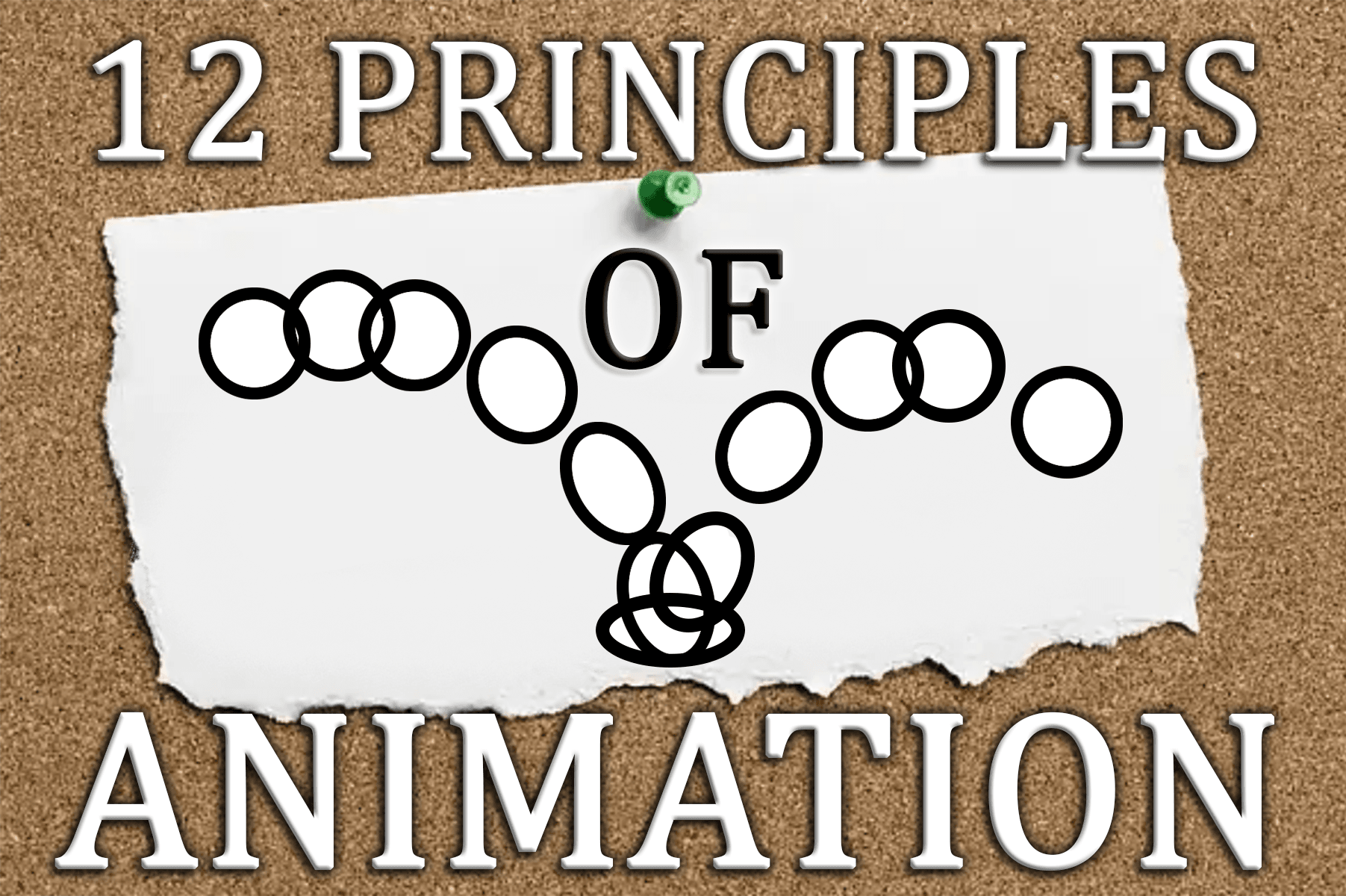
- Squash and Stretch gives the illusion that the object has weight, flexibility, and elasticity. Gravity is one of the main laws of physics that squash and stretch honors. When the ball, seen above, is returning to the ground after an arch, gravity pulls harder on the object and extends its shape. When the object hits the ground it’s mass compresses upon impact.
- Squash: the elasticity that appears during impact and compresses the mass of the object on horizontal axis
- Stretch: the elasticity that appears before impact (gravity force) and after impact (recoil force)
Anticipation
Anticipation is the motion that prepares the viewer for the next action. For example, the few seconds before a person jumps, they bend their knees. Or how a baseball pitcher pulls their arm back before throwing it to the batter. Without anticipation, the animation could look unrealistic and also cause the viewer to miss the action that wasn’t properly anticipated.
Staging
Just like in a movie, staging involves anything from the lighting to the position of the camera and actors. Close-ups, medium shots, and master shots each convey a different effect that can change how a viewer follows the story. Staging helps focus the viewer to where the story is being told. For example, there can be action in the background of a scene, but centering or focusing on the main action can help the viewer narrow in on that action and not be distracted by an extra in the background.
Straight Ahead Action and Pose to Pose
“Straight Ahead” and “Pose to Pose” are two methods of animation that achieve the same results but are executed very differently.
- Straight Ahead: In this type you would begin with one drawing and continue to draw frame by frame until you are are finished. For example, in flip books, animators draw one picture after each other until the end. This form of animating can lead to more realistic and fluid movements but can frequently cause animators to lose track of the volume or shape of the original drawing.
- Pose to Pose: In pose to pose, animators create drawings for the beginning, middle, and end of an action, otherwise known as “key frames.” After doing so, they continue to connect those frames with drawings known as “in-betweens.” This method offers a more prepared way of animating that ensures it’s objects won’t morph in shape or size.
Follow Through and Overlapping Action
“Follow Through” and “Overlapping Action” both reinforce the idea that the main body and the other parts of the character have different speeds and motions when moving. A robot may not have any follow through or overlapping action when slamming on the brakes, but a human will (and may suffer whiplash).
- Follow Through: A good example of follow-through is a character’s hair moving after the head stops moving. After following through, the hair returns to the center of the character’s mass. Follow through is when parts of an object continue to move after the object has stopped.
- Overlapping Action: Because objects have multiple parts, like arms and legs, they can often overlap. In overlapping action, the timing of the main object and its parts are offset. The head could be moving faster while the hair could be moving slower.
- Drag: Drag refers to the delay of movement of parts in relation to the main object.
Ease-in and Ease-out
This principle of animation refers to the idea that no object moves at a constant speed. Not even a Tesla. Objects accelerate and decelerate. To create the effect of certain speeds, animators either need to draw more frames in slower speed and less frames in higher speeds. Like in the bouncing ball animation, when the ball is for a brief moment suspended in air, it’s speed is much slower than when it is falling.
Arcs
All natural being’s movements do not move in a straight line, but an arc. For instance, try waving your arm with your hand moving in a straight line. Looks weird doesn’t it? That’s because the natural movement of hand-waving is in an arc pattern. Without arcs, your animation will look quite stiff and unrealistic. Traditional animators drew arcs lightly on each drawing to make sure that their movements were realistic.
Secondary Action
The secondary action of a scene is the movement that accentuates the main movement but doesn’t distract away from it. For instance, the main action could be a man playing the piano and his secondary action is his head moving back and forth. While it doesn’t take precedence over his fingers on the keys, it adds personality and character to the scene. Secondary actions can also be facial expressions.
Timing
Timing refers to the number of drawings or “frames” used to convey the speed or smoothness of an action. With less frames, the movement will be quick and sharp while more frames will be smooth and slow. Most animations are timed at 24 frames per second. This means that during a second of animations the viewer will see 24 drawings played after each other. Those 24 frames can either show a lot of movement or little based on the speed and volume of the object. Timing can also convey a lot about a character’s personality and emotion.
Exaggeration
In animation, the more dramatic the better! Well, sometimes. Creating exaggeration to normal facial expressions can convey the behavior and personality traits of a character. More realistic animation like Snow White differ stylistically from exaggerated animations like Looney Toons.
Solid Drawing and Solid Posing
In order to create a life-like character, animators must be knowledgeable about the various aspects of life drawing. This includes: three-dimensional shapes, anatomy, balance, weight, light and shadow, etc. Poses should be express the thoughts, personality, and emotions of the character.
Appeal
Appeal is simple. Is the character interesting and relatable? The expressions and actions need to be captivating and easy to read. Maybe one day you’ll create a character as appealing as Mickey Mouse!
 Barrett's Studio